
In today’s FX market, liquidity quality can define a brokerage’s success just as much as spreads or execution speed. Traders expect tight pricing, minimal slippage, and consistent order fulfillment regardless of market conditions. For brokerages, meeting these expectations means managing multiple liquidity streams while navigating volatility, uneven order flow, and rapid shifts in trading volume: all without disrupting the client experience.
A liquidity aggregator helps brokerages meet these demands by unifying liquidity from various providers into a single, optimized pricing stream. It enables better risk management, better pricing, and greater control over execution.
In this article, we explore what a liquidity aggregator is, how liquidity aggregation functions, and why it has become an essential infrastructure component for forex brokerages aiming to scale and compete effectively.
What is a Liquidity Aggregator?
A liquidity aggregator is a technology solution that consolidates price feeds and available liquidity from multiple liquidity providers, such as banks, exchanges, and prime brokers, into a single, unified order book. By sourcing liquidity from several providers simultaneously, brokerages can deliver tighter spreads, deeper market depth, and more competitive pricing than relying on a single liquidity source.
Beyond price optimization, a liquidity aggregator plays a crucial role in risk management. It allows brokerages to control order routing, manage exposure across providers, and automatically distribute risk based on predefined rules. Large orders can be split across multiple liquidity sources to minimize market impact, while exposure can be balanced in real time to prevent over-reliance on any single provider.
Backup liquidity is another key function of a liquidity aggregator. If one liquidity provider disconnects, widens spreads, or reduces available volume during volatile market conditions, the system automatically reroutes orders to alternative providers. This redundancy ensures uninterrupted trading, stable pricing, and continuous execution — even during periods of market stress or technical outages.
In essence, a liquidity aggregator is a core infrastructure component for modern FX brokerages. It enhances pricing quality, strengthens risk management, and provides operational resilience through backup liquidity. As markets become more dynamic and competitive, liquidity aggregation enables brokerages to maintain control, stability, and performance across all trading conditions.
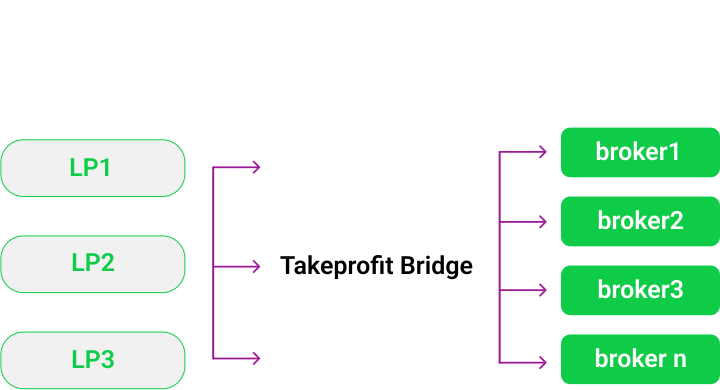
Why Liquidity Aggregation Matters
Better pricing
Liquidity aggregation enables brokerages to source quotes from multiple liquidity providers simultaneously, selecting the best bid and ask prices in real time. Instead of relying on a single provider’s pricing, the aggregator continuously compares available quotes to construct the tightest possible spreads. This results in more competitive pricing for traders and a stronger overall value proposition for the brokerage.
In addition to tighter spreads, aggregated liquidity helps stabilize pricing during volatile market conditions. When one provider widens spreads or pulls liquidity, others can compensate, ensuring continuous price availability. This consistency is critical for maintaining trader confidence and reducing pricing disruptions during fast-moving markets.
Deeper market access
By combining liquidity from multiple providers, a liquidity aggregator creates a deeper order book with greater available volume at multiple price levels. This depth allows brokerages to support higher trading volumes and accommodate larger orders without significant price impact. Traders benefit from improved fill rates, while brokerages gain the capacity to scale their operations more effectively.
Deeper market access also opens the door to a wider range of instruments and trading strategies. With broader liquidity coverage, brokerages can offer more currency pairs, exotic instruments, and advanced order types, appealing to both retail and institutional traders.
Improved execution
Liquidity aggregation significantly enhances execution quality by routing orders to the most suitable liquidity source. Orders can be filled based on price, speed, volume, or execution reliability, reducing slippage and minimizing requotes. This is especially important during periods of high volatility, when execution performance can make or break the trading experience.
For large or complex orders, the aggregator can split trades across multiple liquidity providers to achieve better average fill prices. This smart order handling improves execution efficiency while reducing market impact, helping traders achieve more predictable and transparent outcomes.
Greater stability and risk control
Beyond pricing and execution, liquidity aggregation provides brokerages with greater control over risk and operational stability. By distributing order flow across multiple liquidity providers, brokerages can manage exposure more effectively and avoid dependency on a single counterparty. Risk parameters and routing rules can be adjusted dynamically to align with changing market conditions.
Equally important, a liquidity aggregator ensures backup liquidity in case of provider outages, degraded pricing, or sudden liquidity withdrawal. This redundancy safeguards uninterrupted trading, protects the brokerage’s reputation, and ensures consistent service delivery, even during market stress or technical disruptions.
How Liquidity Aggregator Technology Works
Data connection and API integration
A liquidity aggregator connects a brokerage to multiple liquidity providers through APIs and FIX protocols, enabling the continuous exchange of real-time market data. These connections stream bid and ask prices, available volumes, execution parameters, and provider status updates. Incoming data is normalized into a unified format, ensuring seamless interoperability between liquidity sources with different technical standards.
This connectivity layer is designed for low latency and high reliability. It allows brokerages to onboard, manage, and replace liquidity providers without disrupting trading activity, forming the foundation for stable pricing and consistent execution.
Aggregation algorithm
The aggregation algorithm consolidates incoming price feeds from all connected liquidity providers into a single, optimized order book. It continuously evaluates quotes to determine the best bid and ask prices at each depth level, taking into account available volume, execution quality, latency, and provider reliability.
Advanced aggregation logic adapts dynamically to market conditions. If a liquidity provider widens spreads, reduces volume, or disconnects, the algorithm recalculates pricing using alternative sources, ensuring uninterrupted price streams and competitive spreads.
Order routing and execution
When an order is received, the liquidity aggregator applies smart order-routing logic to identify the most efficient execution path. Orders are routed based on predefined criteria such as price priority, available liquidity, execution speed, and risk limits. Larger orders can be automatically split across multiple liquidity providers to reduce market impact and improve average execution price.
This automated execution process minimizes slippage, reduces requotes, and maintains execution quality during volatile market conditions. Real-time routing adjustments ensure reliable trade execution across varying liquidity environments.
Market watch
Market Watch displays aggregated prices as they are delivered to clients, including applied markups. It provides a real-time view of all symbols available through the liquidity aggregator, along with market depth where available, allowing brokerages to assess the quality of pricing and liquidity presented to traders.
Users can view both a complete symbol list and detailed depth information for a selected instrument. Each symbol can be clicked to explore its order book, while visual chart representations illustrate liquidity distribution across price levels. This visibility helps ensure pricing accuracy, transparency, and consistent client-facing execution quality.
Dashboards for risk control
Monitoring and risk management dashboards provide real-time visibility into trading activity and exposure across the liquidity aggregator. They track orders flowing from clients to liquidity providers and from providers back to customers, as well as execution latency, rejected orders, and system errors. This enables brokerages to monitor operational performance and quickly detect execution issues.
The dashboards also include detailed profit and loss analytics, client equity and balance metrics, top winning and losing accounts, and additional risk indicators. By centralizing execution data and financial metrics, brokerages can proactively manage exposure, identify abnormal trading behavior, and maintain stability, profitability, and risk control under all market conditions.
Considerations for Implementing a Liquidity Aggregator Successfully
Technology infrastructure requirements
Effective liquidity aggregation depends on ultra-low-latency systems, high-performance servers, and resilient infrastructure.
Without these, brokerages risk execution delays, slippage, and downtime. Investing in robust cloud hosting with 24/7 monitoring, failover mechanisms, backup systems, and smart routing algorithms is essential to ensure uninterrupted performance.
Regulatory compliance considerations
Liquidity aggregation must comply with regulatory frameworks such as MiFID II and NFA standards, which require transparent pricing, client data protection, and full trade auditability.
This involves maintaining detailed trade logs, audit trails, and reliable reporting tools. Regular compliance checks are critical, as non-compliance can lead to penalties and reputational damage.
Integration and platform compatibility
A liquidity aggregator should integrate seamlessly with the broker’s trading platform and the selected liquidity providers. Equally important is compatibility with internal systems, including CRM platforms, payment solutions, and reporting tools, to ensure smooth, end-to-end operations across the entire trading ecosystem.
Cost and scalability planning
When assessing costs, brokerages should account for setup fees, hosting, volume-based charges, and any additional development required to support future customization or expansion.
Equally important is scalability. The aggregator must support increasing trading volumes without performance degradation. Choosing a scalable solution reduces long-term costs and avoids frequent system replacements as the business grows.
Customer care and ongoing support
Reliable customer care is a critical but often overlooked factor in successful liquidity aggregation. Brokerages require timely technical support, proactive issue resolution, and expert assistance during onboarding, upgrades, or market disruptions. Delays in support can directly impact execution quality and client satisfaction.
A strong customer care framework includes 24/7 technical support, dedicated account managers, and access to experienced liquidity and infrastructure specialists. This level of support ensures smooth operations, faster problem resolution, and long-term reliability of the liquidity aggregation setup.